A Decade of Design Legacy: Reflecting on the Investcorp Building at Oxford

It’s hard to believe that it’s been ten years since the Investcorp Building at Oxford University’s Middle East Centre opened its doors. What might appear as a modest intervention within the historic campus of St Antony’s College has, over time, become one of the most meaningful architectural experiences of my career, not just for the end result, but for the journey it demanded from all of us who brought it to life.
A Pilgrimage for Context: Denmark, Zaha Hadid, and the Spark of Understanding: Early on, our design team made a trip to Denmark to visit the Zaha Hadid-designed Ordrupgaard museum extension there. This wasn’t just a site visit. It was an intentional deep dive into the conceptual DNA of a project that carried similar spatial ambitions. We explored its history, studied its construction up close, and absorbed the narrative strategies that informed its form.
That visit shaped how we approached the Oxford project, from respecting the historical and environmental context to embracing material experimentation and spatial choreography. It was a pivotal moment that reminded us: to innovate meaningfully, you must first listen deeply.
The Sequoia, the Site, and the Dumbbell: At the heart of our Oxford site stood a proud - “TPO knighted” towering - century-old Sequoia tree, protected, revered, immovable. Instead of seeing it as a constraint, we treated it as the spiritual anchor of the building. Our design response was what we fondly referred to as the “dumbbell”; a poetic connector threading together two adjacent Victorian buildings, the vicar’s lodge, and sided by a curious 1960s structure.
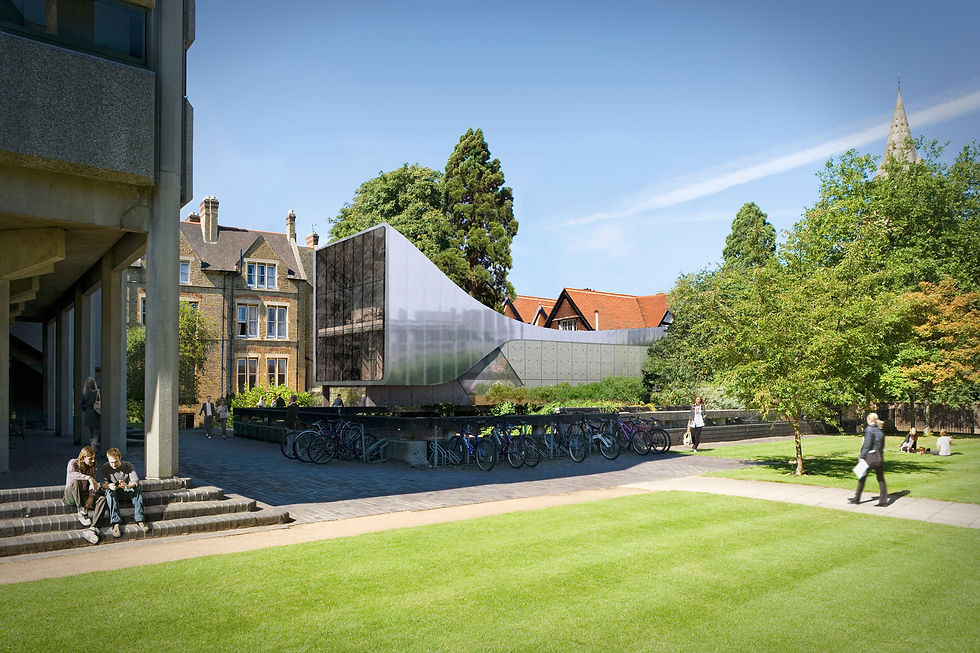
Crafting this connector required countless hours of collaboration. I worked closely with Goswin Rosenthal & Ken Bostock (probably still works at ZHA!), obsessing over every detail of the parametric skin that would define the building’s façade, a perforated, fluid surface that simultaneously embraced the tree and captured light in ever-changing patterns. It was less about imposing form, and more about composing harmony between history, material, and nature. This project had to offer something daring to Oxford!
The Interior: Curves That Speak Softly
Step inside, and the language changes again. Gone is the high-tech steel shell, replaced by a set of flowing, curved interiors that feel soft, intentional, and almost surreal – nothing less than a Zaha Hadid dent. The ellipse staircase, the cocooned library, the absence of visual structural weight all contributes to a space that invites curiosity rather than demands attention.
The double-height glazed façade on one end animates the internal courtyard (remember the 1960s funny looking side building?), allowing transparency and light to breathe life into a tight site. Despite its modest footprint, the building succeeds in being both functional and transformational. A true design paradox we were proud to navigate.
From Oxford to Beirut: A Ripple Through Design Thinking: The lessons learned from this project extended far beyond Oxford. They fundamentally shifted how we thought about architecture’s role in shaping knowledge institutions. These insights flowed directly into our later work on the Issam Fares Institute (IFI) at the American University of Beirut (AUB), where we reimagined how design can shape policy dialogue, institutional identity, and regional research impact.

Final Reflections
I’m truly proud to have been one of the designers behind this project and to have contributed to an architectural narrative that continues to inspire a decade later. The Investcorp Building was never just a connector between buildings. It was a connector between cultures, eras, ideas, and design philosophies; it was a Saracen’s dent!
It continues to stand, quietly but confidently, as a gem of innovation nestled in one of the world’s most storied academic landscapes.
Here's to ten years of timeless design, and to the journey it continues to inspire.
If you'd like to explore how architectural design can shape identity, wellbeing, and innovation, feel free to connect or reach out. I am always up for meaningful conversations that push our discipline forward.
Photography by Luke Hayes

The integration of nature with historic and modern elements here is impressive. I’d love to see more projects that respect context while innovating like this. https://batoto.website/genre/supernatural